How LoadGen's No-Code Workload Engine Drives the Open Benchmark for User Experience
LoadGen is the official workload engine and founding sponsor of OBUX, the Open Benchmark for User Experience. A vendor-neutral benchmark for evaluating digital workspaces.
LoadGen Engineering
Product Strategy
In today's digital workplace, performance is crucial for productivity and employee satisfaction. Unfortunately, traditional system benchmarks often miss the mark. They primarily focus on metrics like CPU load, disk latency, or frame rates but do not capture how users actually feel about their experience. This gap is why we at LoadGen take pride in being the official workload engine provider and founding sponsor of OBUX, the Open Benchmark for User Experience.
The Vision Behind OBUX
OBUX aims to create a transparent, robust, and vendor-neutral benchmark for evaluating digital workspaces. This initiative focuses on several key areas:
System performance (CPU, disk, memory, GPU)
User experience (responsiveness, satisfaction, frustration)
Environmental impact (e.g., CO₂ consumption)
These dimensions are synthesized into a composite score that reflects not just the system's capabilities but also the user's perceptual experience. This dual focus enables IT leaders, architects, and engineers to make well-rounded decisions based on both technical data and human experience.
The Integral Role of LoadGen in the OBUX Ecosystem
To achieve precise and reproducible benchmark results, realistic, consistent, and scalable user simulation is essential. This is where LoadGen excels.
No Code, High Fidelity
With LoadGen’s no-code workload engine, OBUX can effortlessly simulate typical user activities. These activities include:
Opening and using productivity apps like Outlook, Word, and Excel
Conducting transactions in vital business applications such as CRM, EMR, and ERP
Launching virtual desktops or remote sessions
This entire process is configured through LoadGen’s intuitive visual interface, requiring no scripting and making it accessible to engineers, consultants, and QA teams alike.
Repeatable and Modular Transactions
Each workload consists of modular transactions-the fundamental units of user activity. These transactions are orchestrated to form user scenarios that can be executed across multiple virtual users and environments. Transactions may cover:
Keystrokes and mouse actions
File I/O operations
Response time checkpoints
Each action is timed, logged, and scored, allowing for a comprehensive assessment of responsiveness, stability, and consistency.
Understanding the OBUX Scoring Model
The OBUX scoring system blends objective system metrics with subjective user perception. This balanced approach produces a more comprehensive understanding of performance.
Two Dimensions of Scoring
System Score (Absolute):
Based on hardware and OS-level performance metrics.
Includes CPU load, memory utilization, disk latency, and system response times.
User Experience Score (Relative):
Advances perceived UX on a scale from 0.00 (unacceptable) to 0.94 (perfect).
Anchored to human-centric categories:
0.00 = Absolutely unacceptable
0.50 = Just fair
0.70 = This is good
0.94 = Perfect
Composite Formula Example
This scoring formula ensures that both technical efficiency and subjective quality contribute to the final benchmark results.
Transactions as the Foundation of Insight
Every benchmark generated by LoadGen is composed of multiple sessions with repeated transactions. These transactions are the core data points that inform OBUX metrics.
Each transaction is:
Timestamped and compared to expected performance thresholds.
Measured for duration, jitter, and resource utilization.
Linked to environmental impact (e.g., energy consumed → CO₂ equivalent).
These metrics provide vital insights, allowing OBUX to correlate system strain, user perception, and environmental footprint in a unified benchmark result.
Promoting Transparency and Collaboration
LoadGen is integrated into OBUX as an open and transparent workload generator, ensuring the entire testing flow is reproducible and verifiable:
Benchmark definitions are published openly for scrutiny.
Metrics are stored in InfluxDB.
Visualizations are crafted using Grafana.
Community contributions are encouraged on GitHub.
Additionally, the LoadGen engine supports plugin-based extensions, enabling contributors to introduce custom applications, edge cases, or vertical-specific workloads, such as healthcare EMRs, financial dashboards, or CAD software.
Future Directions for OBUX and LoadGen
With LoadGen leading workload simulation and OBUX establishing the structure and scoring logic, the first public version of the benchmark is set to launch at the end of 2024. The target venues for this launch include EUCworld and E2EVC.
Here are some avenues we are exploring:
Offering free and discounted LoadGen licenses for OBUX contributors.
Introducing pre-built workload packs for popular use cases.
Enhancing real-time feedback utilizing AI/LLM-assisted UX interpretation.
Conclusion: A Partnership for Progress
The collaboration between LoadGen and OBUX signifies a powerful synergy where precision engineering meets open benchmarking. Together, we empower IT professionals to look beyond hardware metrics and focus on the real-world user experience.
Interested in being a part of this groundbreaking evolution?
Visit obux.it Explore LoadGen
Related reads
Keep reading.
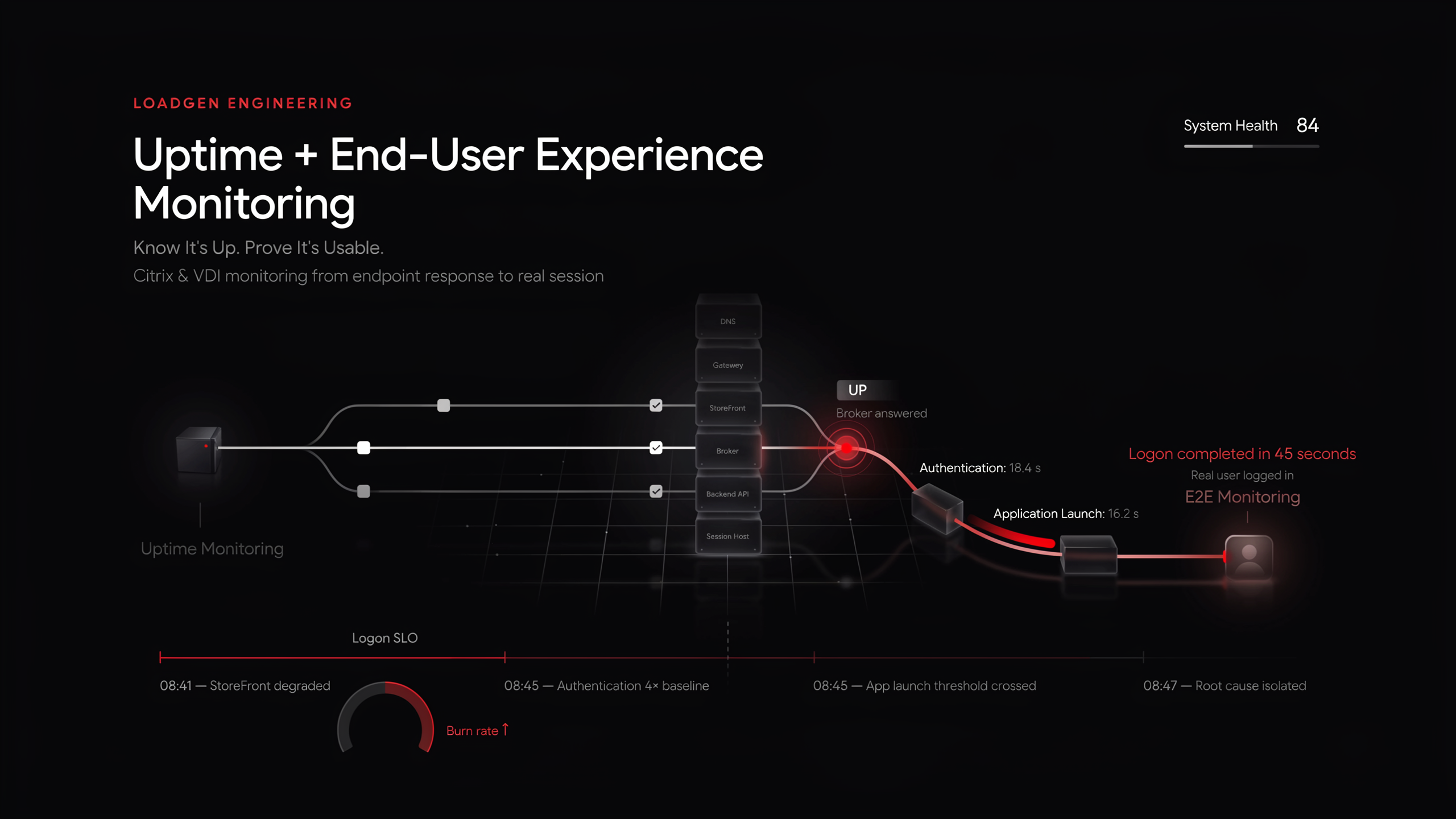
Uptime Monitoring + End-User Experience Monitoring for Citrix & VDI | LoadGen
Uptime says the broker answered. End-to-end monitoring says a real user logged in, and did it in 45 seconds. Why VDI needs both, and how to run them on one platform.
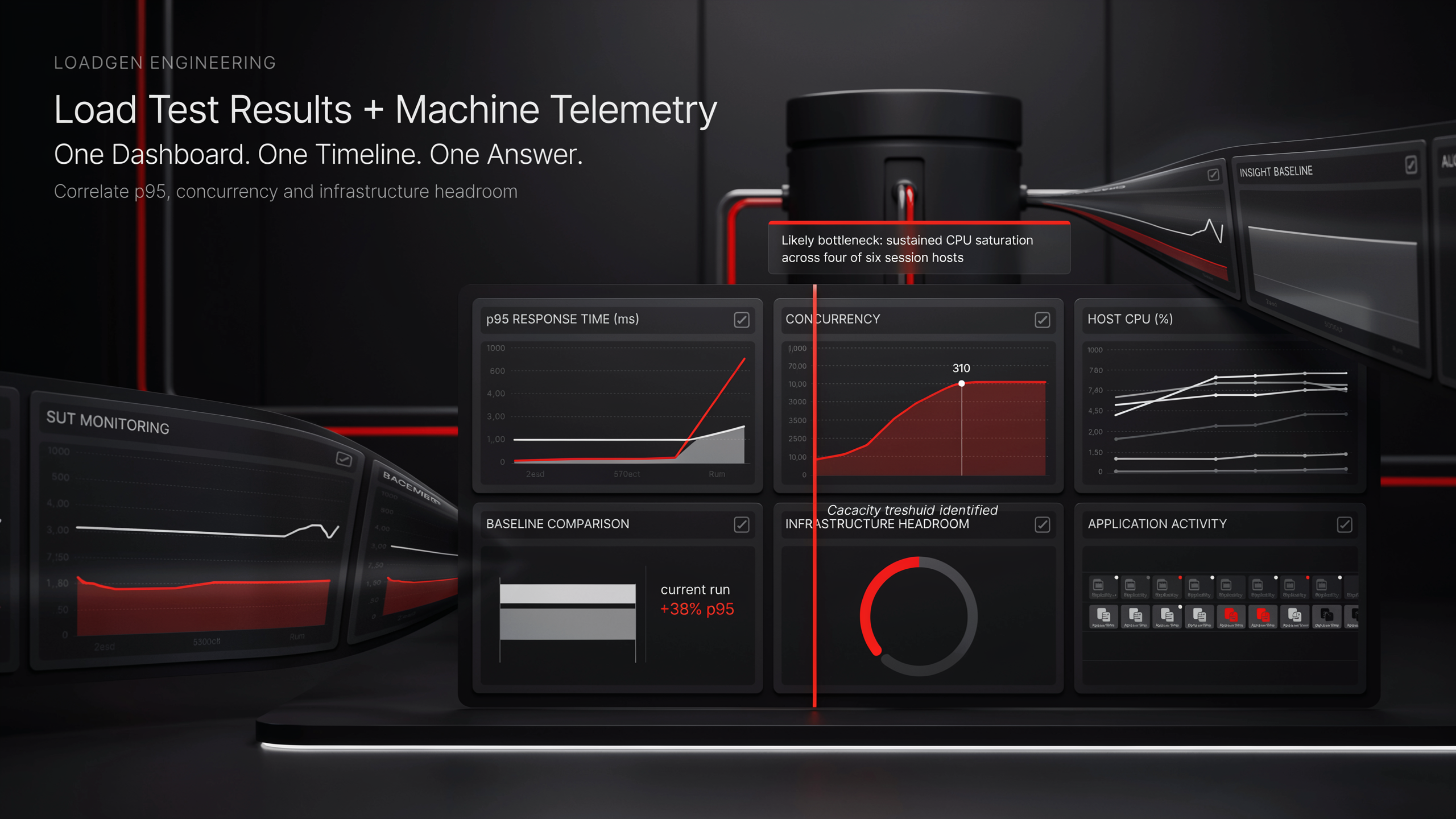
Combine Machine Telemetry with Load Test Results in One Dashboard | LoadGen
Load tests tell you p95 went up. Machine telemetry tells you why. Build one dashboard over both, in LoadGen Analyse with AI or in Grafana over the same InfluxDB.
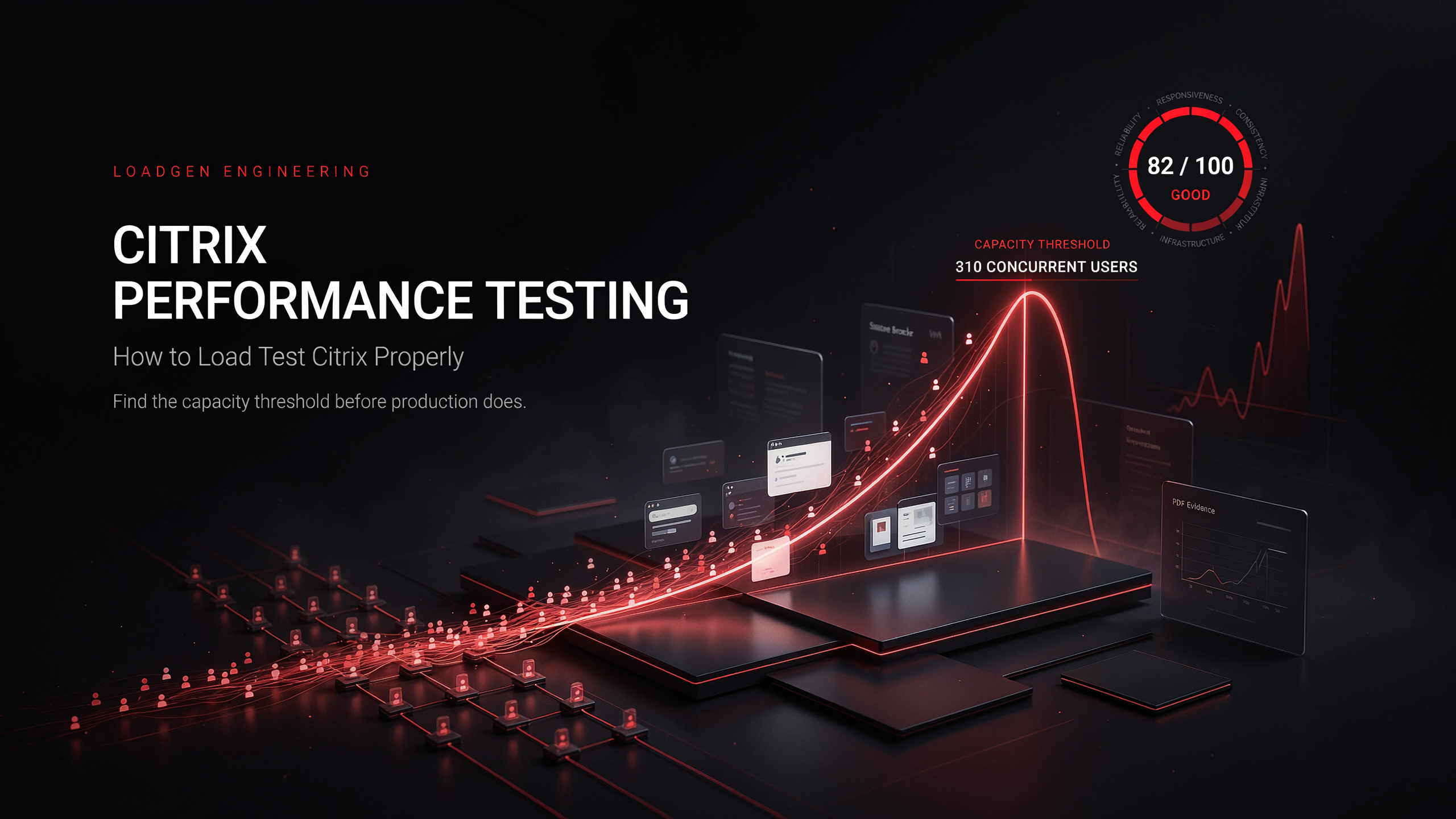
Citrix Performance Testing: How to Load Test Citrix Properly | LoadGen
How to load test Citrix: what to simulate, how to ramp, what to measure, and how to turn a run into a defensible "how many users fit" answer.
Ready to baseline your environment?
Run the wizard, hit the cockpit, watch the audit trail build itself.
